How To Play A Distribution Game In FMCG sector, Retail Audit & Store Census
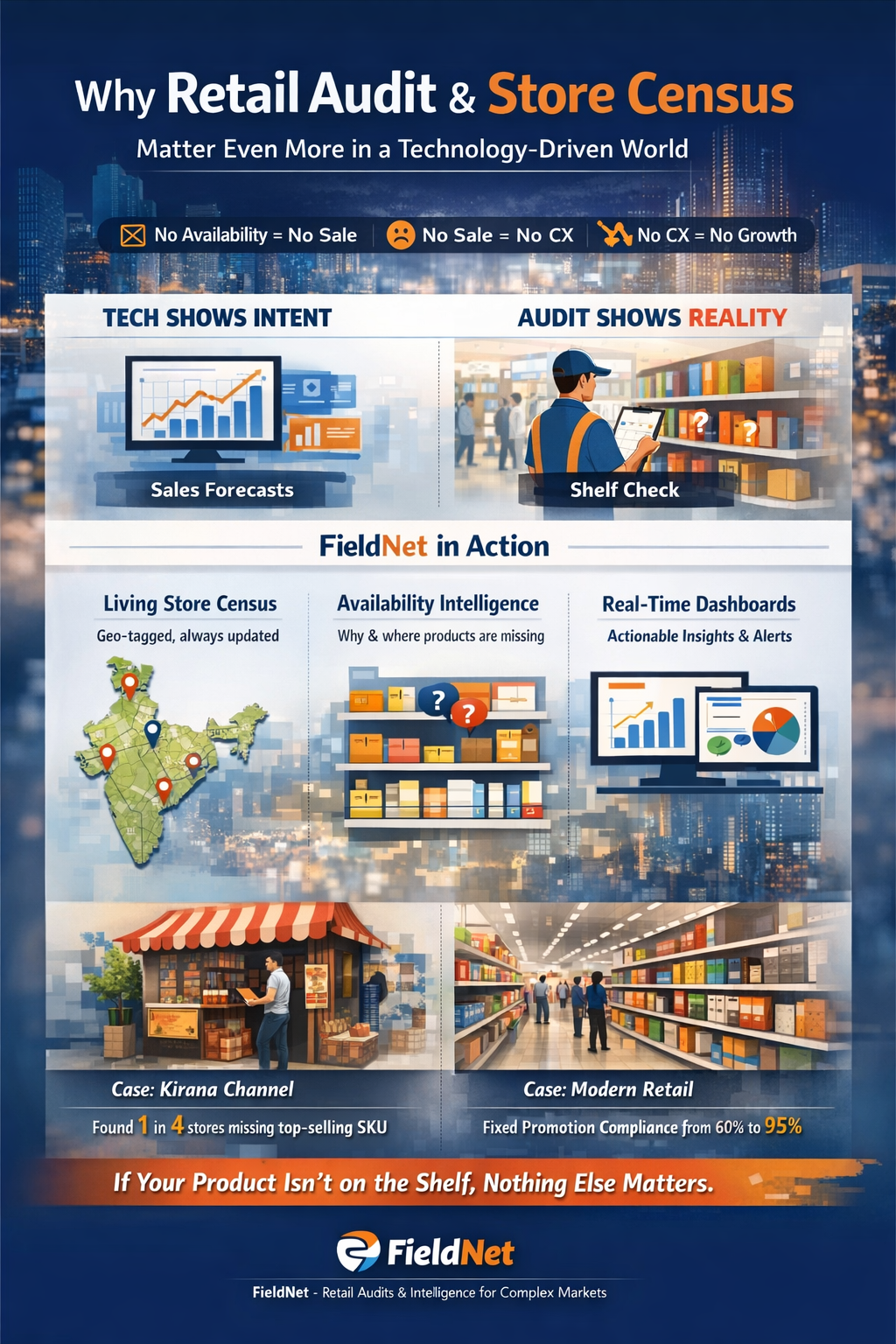
Why Availability Still Decides Growth in a Tech-First World
The Blind Spot in Modern Growth Dashboards
India’s CX heads, founders, and growth leaders today operate with more dashboards than ever before. Forecasting tools are sharper. Marketing attribution is smarter. Sales analytics refresh in near real time.
Yet, one uncomfortable truth remains:
Products are still sold in physical stores.
And in India’s fragmented retail ecosystem, the biggest risk to growth is not lack of demand—but lack of availability.
Retail Audit and Store Census services are no longer legacy research tools. They have become critical decision infrastructure for brands that want predictable growth in complex markets.
Why Retail Visibility Is a Strategic Advantage in India
India’s retail landscape is vast, diverse, and constantly changing. New stores open, formats evolve, distributors change, and competitive intensity shifts quietly at the shelf.
CX heads, sales leaders, and founders repeatedly face the same unanswered questions:
- How many stores actually sell my category?
- Where exactly am I losing sales due to non-availability?
- Are my SKUs present where demand exists?
- Is my distribution data matching on-ground reality?
When these questions remain unanswered, growth decisions are based on assumptions.
This is where Retail Audit and Store Census move from being a research exercise to a strategic growth lever.
Retail Audit vs Store Census: Understanding the Difference
What Is a Retail Audit?
A retail audit is a systematic, on-ground measurement of retail execution across stores. It captures what is happening at the shelf—the true moment of truth.
Retail audits typically track:
- Product and SKU availability
- Assortment depth
- Shelf share and visibility
- Pricing and promotions
- Planogram compliance
- Competitive presence and substitution
Unlike secondary sales or distributor reports, retail audit reveals what the shopper actually sees.
What Is a Store Census? Salesmen Secret In FMCG sector
A store census goes one level deeper. It is a complete enumeration of all relevant retail outlets within a geography or category.
Instead of sampling, census answers foundational questions:
- How many stores exist?
- Where are they located?
- Which formats dominate which regions?
- Where are the white spaces for expansion?
In India—where retail databases are often outdated or incomplete—store census becomes the base layer for all go-to-market decisions.
Why Retail Audit & Census Matter More in a Technology-Driven World
There is a common misconception that technology reduces the need for on-ground measurement. In reality, it does the opposite.
Technology Shows Intent. Retail Audit Shows Reality.
- Technology predicts demand.
- Retail audit confirms execution.
If a product is not available at the shelf, demand collapses instantly—no matter how strong the brand or marketing.
No availability = no sale. No sale = no CX. No CX = no growth.
Availability Is the First Customer Experience
Before pricing, loyalty, or promotions come into play, the shopper asks one silent question:
👉 Is the product even there?
Retail audit answers the most basic—and most ignored—CX question.
Secondary Data Fails in Fragmented Markets
In markets like India:
- Billing does not equal shelf presence
- Coverage does not equal availability
- Distributor data often hides execution gaps
Only retail audit and census reveal:
- Actual assortment on shelf
- Competitive displacement
- Revenue lost to stock-outs and substitution
FieldNet’s Point of View: Retail Census as Growth Infrastructure
Most players in retail audit stop at measurement.
FieldNet’s leadership position comes from making retail reality actionable, continuous, and system-ready.
Retail Census Is Not a One-Time Study
FieldNet positions store census as market infrastructure, similar to how maps power logistics platforms.
We build:
- Living store universes, not static lists
- Periodic refresh cycles
- Geo-tagged, classified, analytics-ready outlet data
- Structures designed to plug into SFA, CRM, GTM, and CX systems
This transforms census from a research cost into a long-term growth backbone.
From Availability % to Availability Intelligence
Saying “distribution is 62%” is no longer enough.
FieldNet helps brands move to Availability Intelligence, answering:
- Where availability breaks
- Why it breaks (beat design, channel, SKU, execution)
- Which SKUs cause maximum revenue leakage
- Where competitors are winning through substitution
This directly links retail execution to lost sales and growth outcomes.
The Retail Reality Layer for CX and Growth Teams
Most CX programs rely heavily on surveys and NPS.
FieldNet adds the missing layer: CX at the shelf.
We help brands understand:
- Choice gaps when SKUs are missing
- Friction points at store level
- The gap between brand promise and retail reality
This makes retail audit relevant not only to sales teams, but also to CX heads, strategy leaders, and founders.
How FieldNet Executes at India Scale
Pan-India, Multi-Format Coverage
FieldNet executes retail audits and census across:
- General Trade (kirana, mom-and-pop stores)
- Modern Trade
- HoReCa
- Pharmacies
- Specialty and category-led retail
- Urban, semi-urban, and rural markets
Brands see the complete retail landscape, not just easy-to-measure formats.
High-Resolution, On-Ground Data Capture
Our audits go beyond yes/no availability.
We capture:
- SKU-level presence
- Assortment depth
- Shelf share vs competition
- Visibility elements (POSM, displays)
- Pricing consistency
- Stock-outs and execution gaps
For census, every outlet is geo-tagged, classified, and quality-validated.
Technology-Led Governance and Transparency
FieldNet operates on a field-to-intelligence platform.
Clients receive:
- GPS and time-stamped store visits
- Live fieldwork dashboards
- Automated quality checks
- Faster validation and closures
This eliminates common risks like fake stores, skipped visits, and delayed reporting.
Example 1: Distribution Expansion for an FMCG Brand
An FMCG brand believed it had strong numeric distribution based on distributor reports.
A FieldNet store census revealed:
- 18% of mapped stores had closed or changed format
- Significant white spaces in Tier 3 towns
A follow-up retail audit showed:
- Top-selling SKUs missing in 1 out of 4 active stores
Outcome:
- Beat plans redesigned
- Distribution expansion prioritized by revenue-at-risk
- Availability improvement translated directly into sales uplift
Example 2: New Product Launch Readiness
A consumer brand planned a national product launch supported by heavy marketing.
FieldNet’s pre-launch retail audit identified:
- Low shelf readiness in key launch markets
- High risk of competitive substitution
Corrective actions were taken before launch—protecting marketing ROI and accelerating adoption.
Retail Reality, Measured Right
In India, growth is not lost in boardrooms—it is lost one store at a time.
Retail Audit and Store Census are no longer optional. They are the foundation for reliable growth, CX credibility, and execution excellence.
FieldNet helps brands replace assumptions with retail reality—and turn availability into a competitive advantage.
Related pages: Market Research Company in India | Fieldwork Partner for Global Research | Mystery Shopping & Audit Services
Related pages
https://fieldnetglobal.com/blog/is-your-sales-declining-do-mystery-audit-to-find-out-the-root-cause
https://fieldnetglobal.com/blog/fieldwork-partner-for-global-research
Share this post: