How FieldNet Helps Startups Find the Right Customer Before Product–Market Fit
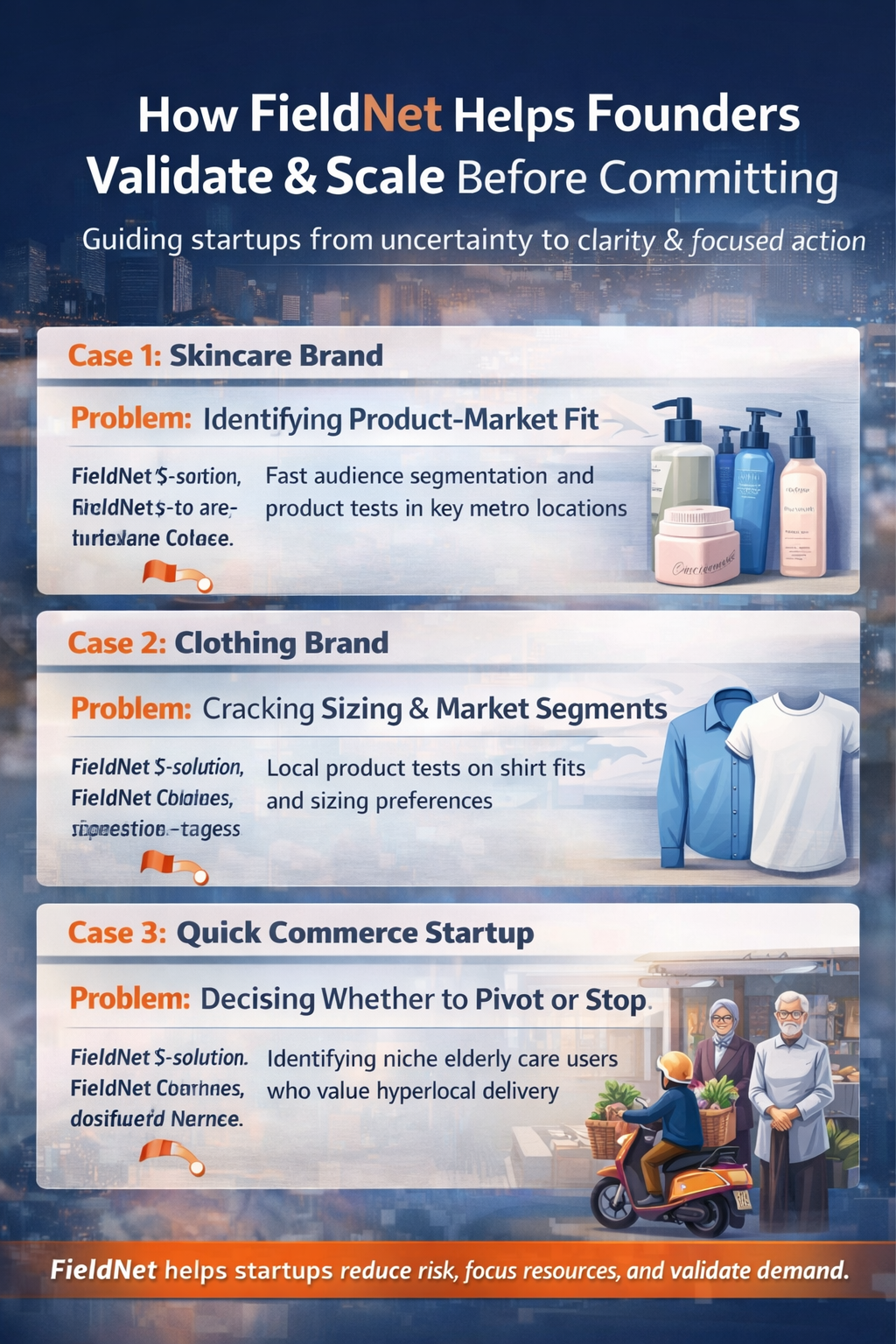
Startup Series: How FieldNet Helps Startups Find the Right Customer Before Product–Market Fit
Most startup failures don’t happen because the product is bad. They happen because the product is built without deeply understanding the customer, context, and usage reality.
At FieldNet, we work closely with early-stage and growth-stage startups to answer one critical question before scale:
Who is the right customer for this product—and will they actually buy it?
This case study series highlights how FieldNet (FinNet) helps startups validate product assumptions, GTM strategy, and customer fit—even with limited budgets and tight timelines.
The Startup Challenge: Validation Without Burning Cash
Startups face a unique constraint:
- Limited budget
- Limited time
- Limited margin for wrong decisions
Yet, the need is high-stakes:
- Identify the right customer segment
- Test product assumptions
- Validate sizing, fit, usage, or concept
- Prioritize launch cities and channels
- Build a realistic go-to-market (GTM) strategy
FieldNet’s role is to act as a customer intelligence partner, not a traditional research vendor.
Case Study 1: D2C Kidswear Brand — Finding the Right Parent, Right City, Right GTM
The Problem
A D2C kidswear startup was preparing for launch with a strong product vision but unclear answers to key questions:
- Who is the real buyer: parent, relative, or gift purchaser?
- What price bands feel acceptable across cities?
- Which cities should be prioritized for launch?
- Does the product communicate value clearly at first touch?
The startup needed GTM clarity before scaling marketing spends.
FieldNet’s Approach
With a limited budget, FieldNet designed a lean, city-focused validation study:
- Recruited parents with children in the target age group
- Covered select Tier 1 and Tier 2 cities
- Conducted concept testing and product evaluation sessions
- Tested pricing perception, purchase triggers, and channel preference
Recruitment was done locally and efficiently—reducing cost while ensuring relevance.
Key Insights Delivered
FieldNet helped the startup uncover:
- Clear parent segments with different purchase motivations
- City-wise variation in price sensitivity
- Strong preference for specific product attributes over others
- Messaging gaps between brand intent and customer understanding
Outcome
- Refined go-to-market strategy
- Prioritized launch cities
- Adjusted product communication
- Avoided unnecessary marketing spend in low-conversion segments
The startup moved forward with confidence, not assumptions.
Case Study 2: D2C Men’s Clothing Brand — Solving the Sizing & Fit Problem
Founder- Nayan Chedda
The Problem
A D2C men’s apparel brand (shirts and t-shirts) was facing a classic but costly challenge:
- Are sizes understood consistently by consumers?
- Is the fit matching expectations across body types?
- Will returns increase due to sizing confusion?
Before large-scale production and launch, the brand wanted to test the product, not guess.
FieldNet’s Approach
FieldNet designed a product testing and sizing validation study under tight constraints:
- Recruited men across defined age and body-type segments
- Conducted in-person product trials in selected cities
- Collected structured feedback on fit, comfort, and perception
- Identified confusion points in size labeling and product description
The recruitment was executed quickly within cities—keeping cost low and turnaround fast.
Key Insights Delivered
- Identified gaps between brand-defined sizes and consumer expectations
- Highlighted fit issues likely to cause returns
- Revealed which customer segments were most aligned with the product
- Clarified optimal sizing communication
Outcome
- Refined sizing strategy before scale
- Reduced risk of returns
- Improved confidence in product-market alignment
- Clearer targeting for launch campaigns
The brand moved to market knowing what works, for whom, and where.
Services | Fieldwork Partner for Global Research | Market Research for Startups
Startup Case Study 3: Quick Commerce → Elderly Care Pivot (COVID-born Venture)
Industry: Grocery / Quick Commerce Stage: Post-launch, revenue decline Challenge: Scale vs shut down decision, limited funds
The Situation
This startup launched a quick-commerce grocery service during COVID. Early traction was strong—similar to the initial wave seen in platforms like Zepto. As mobility returned to normal, revenues dropped and profitability weakened. Despite this, a small but vocal set of loyal customers urged the founders not to shut the service.
The founders came to FieldNet with a critical question: Should we continue scaling, pivot, or shut down to avoid further cash burn?
FieldNet’s Thoughtful Intervention
Instead of benchmarking against large quick-commerce players, FieldNet reframed the problem:
- Who are the loyal customers asking you to stay alive?
- Why are they willing to pay despite alternatives?
The answer revealed a clear insight: elderly customers valued doorstep delivery of fresh vegetables and essentials. They were price-tolerant but service-sensitive.
The Strategy Designed by FieldNet
FieldNet recommended a niche-first pivot instead of mass quick commerce:
- Reposition the product as an elderly care grocery service
- Avoid high-burn city-wide scaling
- Focus on product–market fit before expansion
To solve the customer acquisition bottleneck, FieldNet designed a low-risk validation model:
- Partner with B2B elderly care service providers
- Access verified elderly customer bases ethically
- Onboard users into the existing platform for MVP testing
Execution & Validation
- Defined a clear MVP success timeline
- Set go / no-go decision gates to prevent further cash burn
- Tested willingness to pay, repeat usage, and service expectations
Outcome
- Founders gained absolute clarity on whether to continue or stop
- Business pivoted into a focused, defensible niche
- Product launched successfully at MVP scale
- Capital is preserved by avoiding unsustainable mass scaling
What FieldNet Enables for Startups
Across both cases, FieldNet delivered value beyond traditional research:
1. Lean Product & Concept Testing
- Fast validation
- Budget-conscious design
- Real customers, real contexts
2. Smart Recruitment at Low Cost
- City-level recruitment
- Segment-accurate sampling
- No unnecessary sample inflation
3. GTM Strategy Development
- Segment identification
- City and location prioritization
- Channel and pricing insights
4. Decision-Ready Insights
- Clear gaps and opportunities
- Actionable recommendations
- Reduced risk before scale
Why This Matters for Startups
Product–market fit is not a milestone. It is a process of disciplined learning.
FieldNet helps startups:
- Replace assumptions with evidence
- Avoid expensive mistakes
- Build GTM strategies grounded in reality
- Understand customers before growth pressure kicks in
FieldNet’s POV
Startups don’t fail because they didn’t move fast enough. They fail because they moved fast in the wrong direction.
By helping startups test products, concepts, and GTM strategies early, FieldNet acts as a force multiplier for smart growth.
Related pages: Retail Audit & Store Census
https://fieldnetglobal.com/blog/retail-audit-and-store-census
Share this post: